Trinitarian Controversy (Sources of Early Christian Thought) by William G. Rusch & William G. Rusch
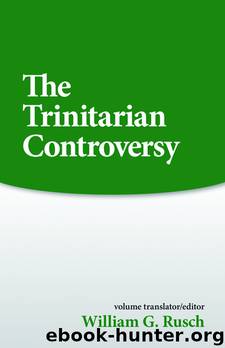
Author:William G. Rusch & William G. Rusch [Rusch, William G.]
Language: eng
Format: azw3
ISBN: 9781451420203
Publisher: Fortress Press
Published: 1980-10-01T04:00:00+00:00
11
Gregory of Nazianzus's Third Theological Oration concerning the Son
(1) Therefore someone might say these things in demolishing the Eunomians’ readiness and quickness about the Word, and also their precariousness in all affairs, but especially in discourse about God. But some reproof is nothing significant; in fact it is the easiest thing that everyone wants to do, and it is the character of a pious and intelligent man to substitute his own judgment. Then with confidence in the Holy Spirit, who is dishonored by the Eunomians but worshiped by us, let us bring into the light our own opinions about the deity—whatever they are—as a noble and opportune offspring. Not that at other times we have been silent, for on this matter we are vigorous and generous. But now even more freely we speak the truth, so that we should not, shrinking back—as it was written—be reckoned in condemnation [Heb. 10:38-39]. Since every argument is twofold, preparing its own defense and overthrowing its rival, and we earlier put forth our own position, we will attempt to overturn opposing views. We will do this in as few words as possible, so that the statements become intelligible, just as the argument they introduced and designed to deceive the more foolish and silly, and so that the remarks are not dispersed by the length of the argument, as water, not restricted by a channel, flows and spreads over a plain.
(2) The three oldest opinions about God are anarchy, government of the many, and monarchy. The first two were toyed with by the children of the Greeks—and let them so play. Anarchy is disorderly, and government of the many is seditious and thus anarchical and thus disorderly. Both result in the same thing—indiscipline—and this leads to dissolution, for indiscipline is the practice of dissolution. Monarchy is the opinion honored by us, yet a monarchy which one person does not determine, for it is possible that the one being in dispute with itself comes into a state of many. It is a monarchy composed of an equality of honor of nature, a concord of mind, identity of movement, and a convergence of things from it to the one, which is impossible for originated nature, so that it differs in number but there is no severance in substance. Therefore, solitary from the beginning, it moved into duality and it took its place as Trinity, and this is for us the Father and Son and Holy Spirit. The Father is the begetter and producer, but I mean without passion, timelessly and incorporeally. The Son is the offspring, and the Spirit the product. I do not know how to name them, altogether removing visible things. We will not dare to mention an overflow of goodness, which a certain Greek philosopher had the audacity to say, as if a certain bowl overflows. He has spoken plainly in those words in his philosophical works about the first and second cause. Then let us not introduce the generation as involuntary, as some natural superfluity, hard to hold, least appropriate for opinions about deity.
Download
This site does not store any files on its server. We only index and link to content provided by other sites. Please contact the content providers to delete copyright contents if any and email us, we'll remove relevant links or contents immediately.
The Secret Power of Speaking God's Word by Joyce Meyer(3409)
Signature in the Cell: DNA and the Evidence for Intelligent Design by Stephen C. Meyer(3185)
Real Sex by Lauren F. Winner(3061)
The Holy Spirit by Billy Graham(3000)
The Gnostic Gospels by Pagels Elaine(2564)
Jesus by Paul Johnson(2408)
Devil, The by Almond Philip C(2372)
23:27 by H. L. Roberts(2273)
The Nativity by Geza Vermes(2248)
Chosen by God by R. C. Sproul(2202)
All Things New by John Eldredge(2195)
Angels of God: The Bible, the Church and the Heavenly Hosts by Mike Aquilina(1985)
Angels by Billy Graham(1971)
The Return of the Gods by Erich von Daniken(1968)
Knowing God by J.I. Packer(1882)
Jesus of Nazareth by Joseph Ratzinger(1841)
The Gnostic Gospel of St. Thomas by Tau Malachi(1826)
Evidence of the Afterlife by Jeffrey Long(1819)
How To Be Born Again by Billy Graham(1810)
